







Board of Peace

The Board of Peace: Founding, Structure, Members, and Its Breakthrough Success Under Donald Trump
This article draws on public reporting and analysis, with particular credit to the detailed video (at bottom of story) presentation by Promethean Action (@PrometheanActn) examining the Board’s recent achievements and the decisive role of economic and institutional leverage.
Before I get into this article please take a moment of your time to watch Jon Voyt’s incredible acting in this short of Ben Franklin at the Convention to the Construction:
In late July 2026, the Board of Peace announced a historic agreement: Hamas and other armed groups in Gaza committed to complete disarmament, to be followed by phased Israeli withdrawal from the territory. The announcement came amid reports of Israel and Lebanon engaging in talks after roughly 30 years. These developments mark a striking shift in a conflict long considered intractable. As Promethean Action highlighted in its analysis, the decisive instrument was not primarily military force. “They’re more scared of Treasury than the War Department,” the video noted, underscoring how financial pressure, institutional design, and economic incentives under President Donald Trump created conditions that pure kinetic approaches had failed to produce.
Origins and Founding
President Trump first proposed the Board of Peace in September 2025 as part of a comprehensive plan to end the Israel-Hamas war and manage postwar Gaza. The concept evolved quickly. In November 2025, the United Nations Security Council adopted Resolution 2803, which welcomed the Board as a transitional body to oversee demilitarization, reconstruction, and governance arrangements in Gaza under the U.S.-brokered framework, with a mandate running through 2027 and requirements to report periodically to the Council.
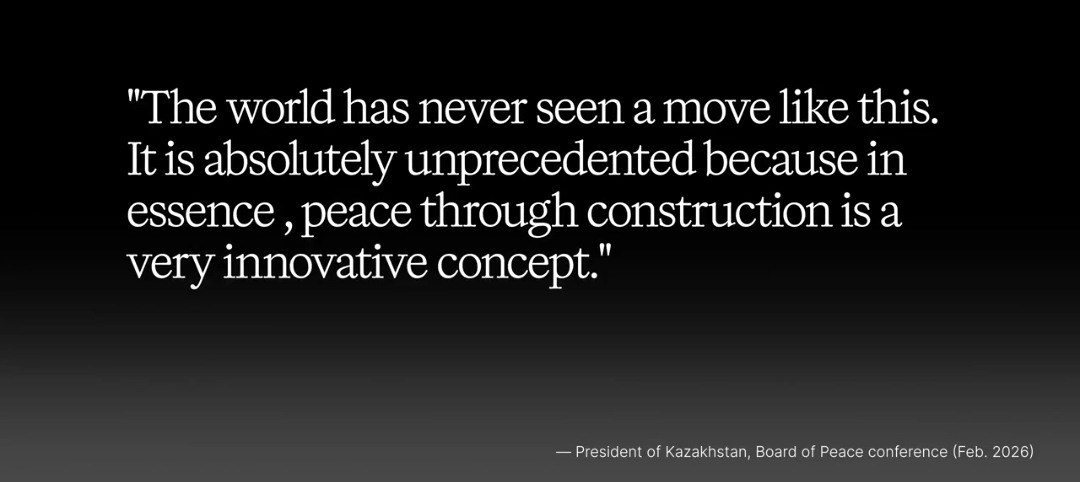
The Board’s charter was formally signed on January 22, 2026, during events connected to the World Economic Forum in Davos, Switzerland. Trump described it as “the Greatest and Most Prestigious Board ever assembled.” Critically, while the original focus was Gaza, the charter language is broader: it establishes an international organization to “promote stability, restore dependable and lawful governance, and secure enduring peace in areas affected or threatened by conflict.” It notably omits specific references to Gaza in the core text, signaling ambition beyond a single theater. Trump serves as inaugural Chairman, with extensive authority under the charter, including the power to invite members, create or dissolve subsidiary entities, and influence succession. His role is structured to continue beyond his U.S. presidency unless he resigns or is removed under limited conditions.
The Board operates outside formal U.N. structures while coordinating with them in practice for the Gaza track. Its headquarters are associated with the renamed Donald J. Trump Institute of Peace in Washington, D.C. Membership carries a distinctive feature: states receive three-year terms, renewable, or can secure permanent status by contributing $1 billion to fund the Board’s activities.
Structure and Key Members
The Board has a layered design:
- Chairman: Donald J. Trump, designated with broad powers.
- Executive Board / founding leadership: Key figures include U.S. Secretary of State Marco Rubio, special envoy Steve Witkoff, Jared Kushner, former British Prime Minister Tony Blair, Apollo Global Management CEO Marc Rowan, World Bank President Ajay Banga, and others such as Robert Gabriel. Nikolay Mladenov has served in a high representative capacity focused on Gaza.
- Broader Board: Composed primarily of national leaders or their representatives from participating countries.
- Supporting mechanisms: These include the National Committee for the Administration of Gaza (NCAG), an International Stabilization Force, and verification bodies for implementation steps such as weapons decommissioning.
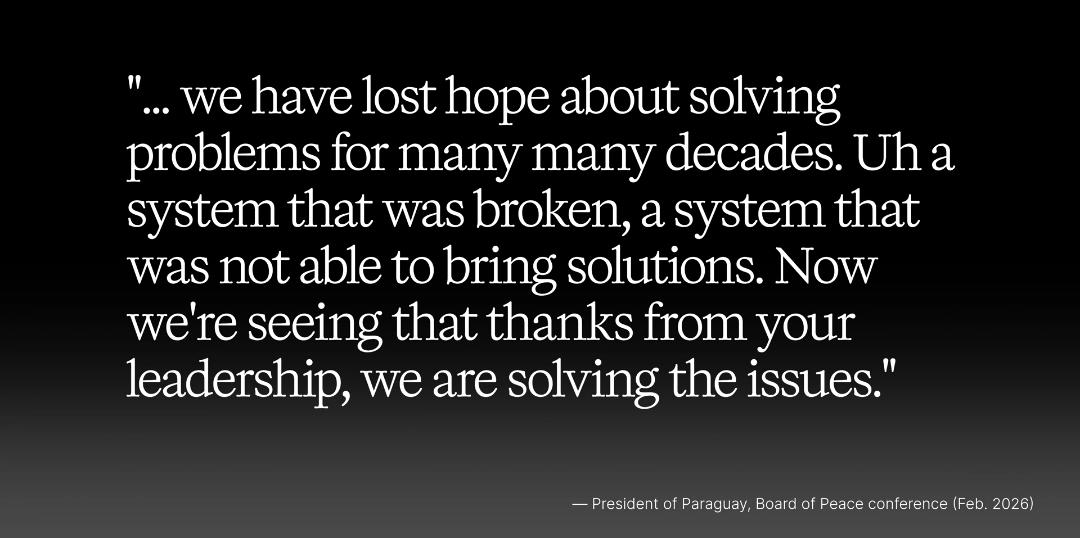
Founding and participating members have included the United States, Israel, Saudi Arabia, Egypt, Qatar, the United Arab Emirates, Bahrain, Jordan, Turkey, Hungary, Pakistan, Indonesia, Argentina, Azerbaijan, Armenia, Kazakhstan, Morocco, Kosovo, Albania, Bulgaria, Paraguay, Uzbekistan, Vietnam, and others—more than two dozen in total according to official listings and reporting. Several Gulf and regional states that helped mediate earlier ceasefire talks joined. Major Western European powers (France, Germany, Norway, Sweden, and others) and some Global South countries declined or remained observers, citing concerns about the Board’s expanded remit and concentration of authority. Russia and China received invitations but did not fully join.
Promethean Action’s analysis emphasizes that this composition—especially the inclusion of key Muslim-majority states alongside Israel—was deliberate. It created a forum of sovereign actors committed to “peace through construction” (economic development and governance reform) rather than the perpetual management of conflict that had characterized earlier multilateral efforts.
The Breakthrough: Disarmament and Regional Momentum
On July 30–31, 2026, Trump announced that the Board of Peace had reached agreement for the total disarmament of Hamas and other armed groups in Gaza. The deal is structured in carefully sequenced phases. Hamas and Palestinian factions committed to an actionable plan for relinquishing weapons, including heavy arms, production sites, depots, and tunnels. Governance and security functions transfer to the NCAG under the principle of “One Authority, One Law, One Weapon.” An International Verification Committee oversees compliance. Israeli forces, which controlled substantial portions of Gaza, are to withdraw progressively as disarmament advances. A new Palestinian police force, supported by an International Stabilization Force, assumes responsibility for internal security. Timelines for detailed mechanisms were set for rapid development (within roughly two weeks of approval, with possible extensions), with full implementation projected over subsequent months.
Board members Egypt, Turkey, and Qatar played essential roles in the negotiations—countries that had been criticized by some Israeli voices for earlier inclusion but proved central to keeping processes alive. Parallel developments included renewed Israel-Lebanon engagement after decades of hostility.
Promethean Action frames these results as the payoff of institutional and economic strategy. Trump first built the Board (launched formally with a major meeting in February 2026 that secured billions in reconstruction pledges), then applied pressure—including military actions earlier in the year that altered regional calculations—while leveraging Treasury and financial tools. Economic isolation, redirected Gulf investment, and the credible alternative of development-focused governance proved more effective at compelling agreement than military operations alone. The video stresses that adversaries and proxies had become more responsive to financial consequences than to conventional force, a dynamic the Trump administration deliberately exploited.
Reconstruction funding commitments have been substantial (U.S. pledges in the range of $10 billion alongside other contributions totaling several billion more), though practical delivery and oversight remain ongoing challenges. The Board’s approach prioritizes demilitarization, deradicalization, civilian administration, and economic rebuilding as interlocking steps.
Why This Succeeded Where Prior Efforts Stalled
Previous international frameworks struggled with enforcement, competing agendas, and the absence of credible alternatives to armed groups’ power. The Board of Peace differs in several respects attributable to Trump’s design and leadership:
- Concentration of authority in a chairman with deal-making experience and willingness to set clear conditions.
- Inclusion of regional stakeholders with direct influence over the parties.
- Explicit linkage of security outcomes to economic development (“peace through construction”).
- Use of financial and institutional leverage alongside (not instead of) military capability.
- Willingness to operate outside legacy structures judged to have failed for decades.
Critics have raised legitimate questions about concentrated power, the Board’s relationship to the United Nations, funding transparency, Palestinian agency, and the risk of overreach. Supporters, including Promethean Action’s analysis, counter that the results—Hamas’s formal commitment to disarmament after years of refusal, movement on Israel-Lebanon talks, and a structured path for Gaza—demonstrate practical superiority over process-oriented approaches that produced little durable change.
Looking Ahead
Implementation remains the decisive test. Verification of weapons decommissioning, sequenced withdrawals, establishment of effective local policing, and actual reconstruction will determine whether the agreement delivers lasting security for Israelis and a better future for Gazans. The Board’s broader global ambitions will also face scrutiny as it considers other conflicts.
What is already clear is that an institution conceived and chaired by Donald Trump, populated with a mix of American officials, regional leaders, and development-oriented figures, achieved a commitment that long eluded prior diplomacy. As Promethean Action’s video argues, the combination of institutional innovation, economic pressure, and clear-eyed realism produced outcomes that pure military or traditional multilateral routes had not.
Credit is due to Promethean Action for highlighting both the concrete breakthrough and the strategic logic behind it. Their analysis provides a useful lens on why the Board of Peace, under Trump’s leadership, has advanced further than many expected in one of the world’s most intractable conflicts.