

Standing Where He Stood: Allatoona Pass, October 2026

Standing Where He Stood: Allatoona Pass, October 2026
One hundred sixty-two years to the day after the guns fell silent, I walked the Allatoona Pass Battlefield in Bartow County, Georgia — the same ground my great-grandfather, John Newton Prentice, defended on October 5, 1864.
John was nineteen when he enlisted in Company A of the 57th Illinois Volunteer Infantry in October 1861. By the fall of 1864 he had survived Fort Donelson, Corinth, the Atlanta Campaign, and Kennesaw Mountain.
On the night of October 4, Companies A and B of the 57th boarded a train in Rome, Georgia, arriving at Allatoona just after midnight.
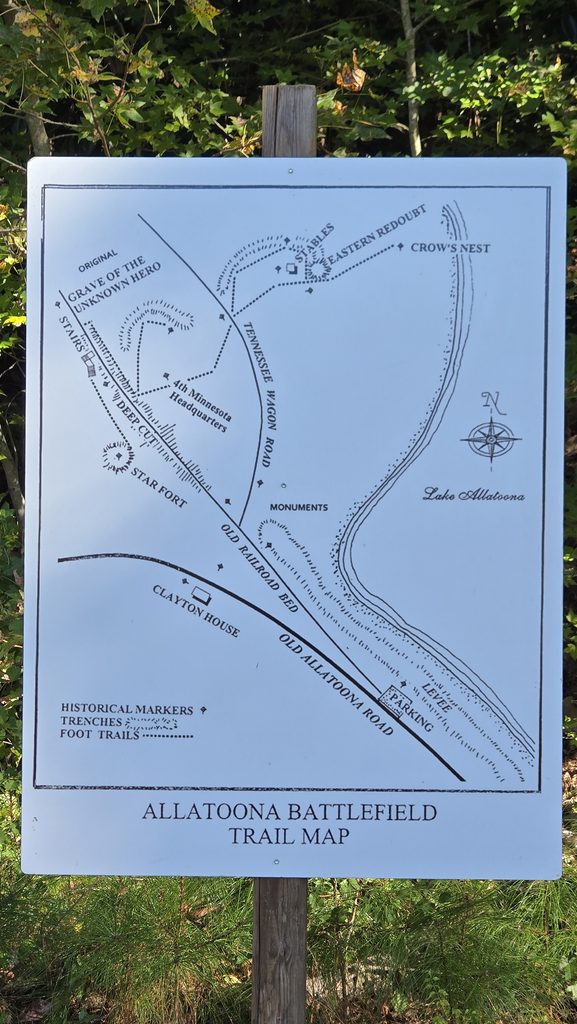
At dawn, Confederate artillery under Major General Samuel French opened fire, and the fighting that followed was among the bloodiest of the entire war for its duration — roughly thirty percent of the five thousand three hundred men engaged became casualties.
The 57th’s official loss that day was three killed, seven wounded, one missing. John’s diary, written the next morning, tells it differently: “We are resting today after the severe fighting of yesterday. Our dead are being buried today. Co. A lost 5 men, our loss is very heavy.” That private’s account, set against the sanitized regimental report, is the heart of what this place means to me.
By eleven that morning, after overrunning Rowett’s Redoubt, the Confederate attack swept up this hill from the west and the north, forcing the Federals to retreat inside the Star Fort. As the last of the fleeing Federals entered, a three-inch ordnance rifle was made ready. Harvey M. Trimble of the 93rd Illinois watched it fire:
“A moment later it was fired. As leaves before a hurricane that mass of enemy was swept from the road. That double charge of grape and canister struck at the feet of the front rank and cut a swath, broad and deep, and of continually increasing breadth, from the front to the rear of the column… the road was red with blood and covered with dead and dying and wounded. It was appalling!”
Between eleven and noon, the Confederates made four separate charges on the Star Fort from the ravine below. Each time they rose into sight, less than a hundred yards away, the Union line rose up and poured a sheet of flame and lead full in their faces. Each time their lines were riddled and their column broken, and again they returned to the protection of the ravine.
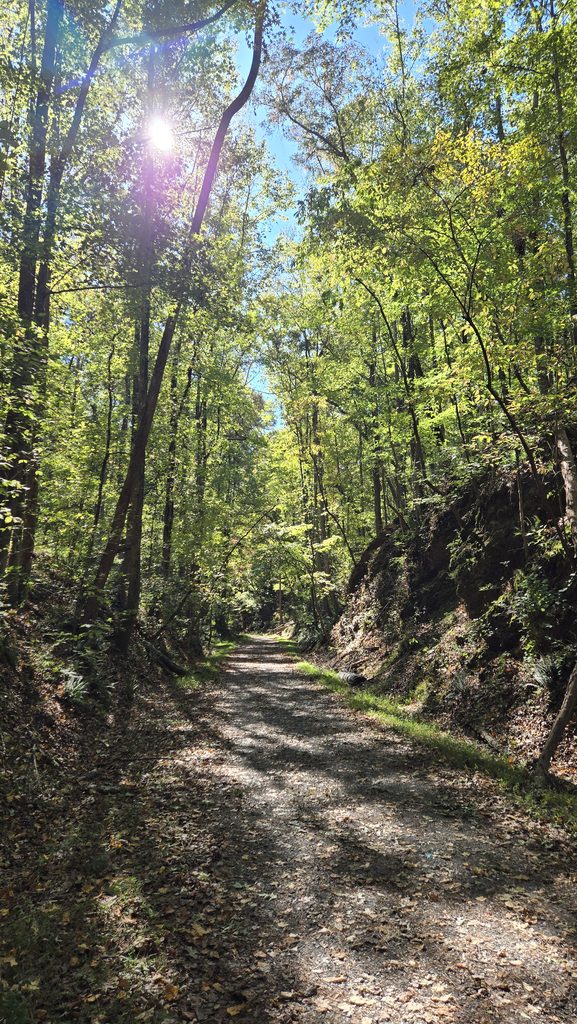
Walking that ground today, the trees are huge — they weren’t there a hundred and sixty years ago. But I knew, in the core of those trees and the earth around me, that the ground has drunk that blood up. The memory and the horror of that day still ride in my spirit. The trees grew over it, but they didn’t grow past it.
The Brady Photograph
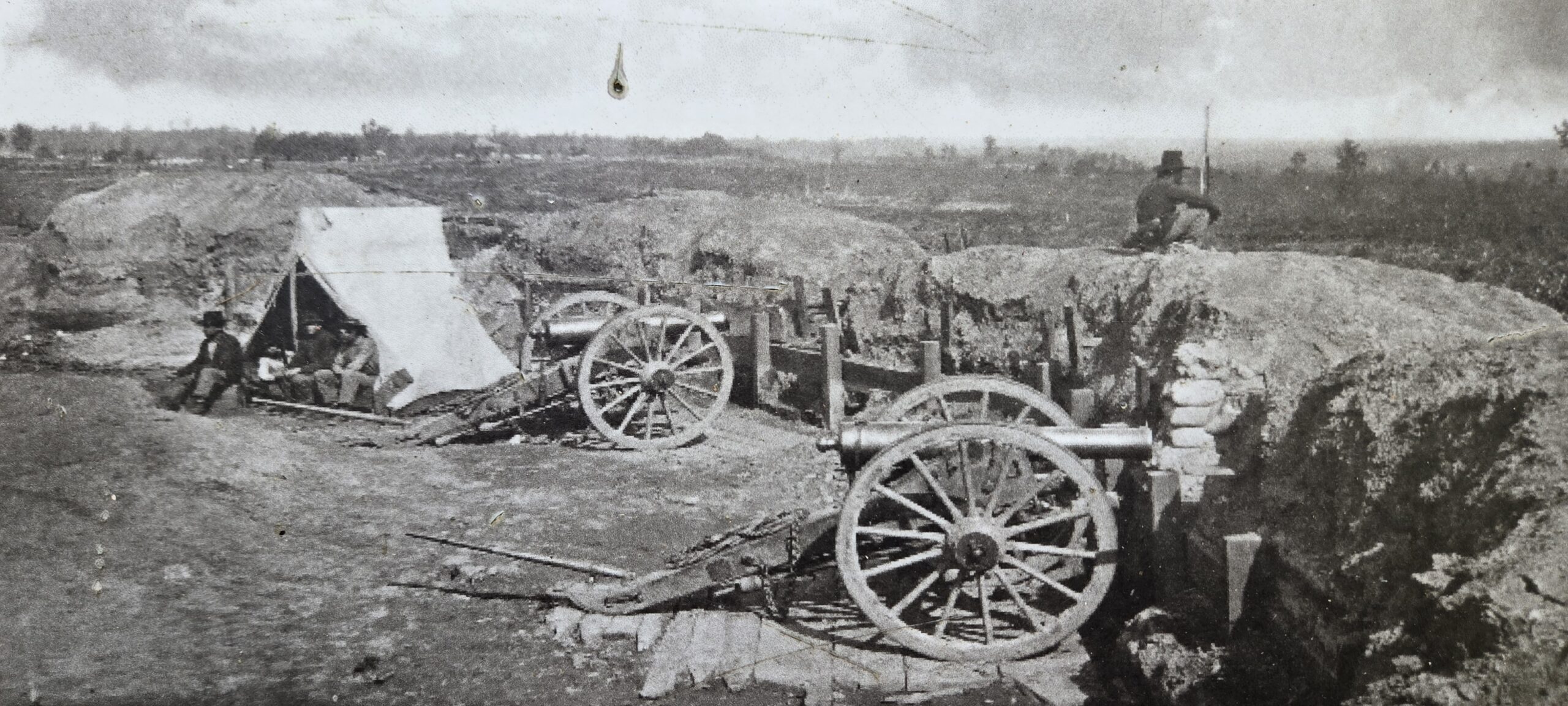
Mathew Brady’s camera arrived within days of the battle. The image shows a three-inch ordnance rifle — the same class of piece that fired that double charge of grape and canister — sitting in an earthen pit with its wheels chained down, a tent pitched behind it, soldiers resting in the shade of the trees. One man sits on the parapet above, rifle across his knees, watching the open ground beyond.
The sign at the Star Fort says the Confederates made four charges up from the ravine below that point between eleven and noon. Trimble’s words capture what those charges cost: “the road was red with blood and covered with dead and dying and wounded. It was appalling!” My color photographs don’t show that road — the trees have closed over it, and the ground I walked frames earthwork and canopy, not the lane the columns came up. But the quote doesn’t need the road in frame. It needs the reader to know the road was there, and that the men in Brady’s photograph were resting on ground where that blood had just been.
Rowett’s Redoubt, where John Newton Prentice’s 57th fought, sat within walking distance of the Star Fort — near enough that the two positions shared the same fight, the same morning, the same smoke. Whether Brady’s lens caught the redoubt or the fort, the image belongs to the same five hours. One photograph, one hillside, one hundred sixty-two years between the shutter and my boots on that soil.
Just past the trailhead lies the Memorial Field, where eleven carved stone markers honor every state that sent men into that fight. I photographed each one.
Union States
Illinois — Six Illinois regiments fought here: the 7th, 12th, 50th, 57th, and 93rd Infantry. The 50th, nicknamed the “Blind Half Hundred,” lost fifteen killed and seventy-one wounded.
Iowa — The 39th Iowa Infantry suffered forty-three killed, fifty-one wounded, and seventy-six captured. Colonel James Redfield was mortally wounded; the town of Redfield, Iowa bears his name. General Corse, who commanded the Union defense, was himself a Burlington, Iowa native.
Minnesota — The 4th Minnesota Infantry, Colonel Tourtellotte’s own regiment, formed the core of the original Allatoona garrison before Corse’s reinforcements arrived.
Ohio — A detachment of the 5th Ohio Cavalry screened the Union position and helped hold the outer lines.
Wisconsin — The 18th Wisconsin Infantry and 12th Wisconsin Battery fought through the day, with three companies of the 18th reinforcing the Star Fort at the crisis point.
Confederate States
Texas — Ector’s Brigade under Brigadier General William Young included the 9th Texas Infantry and the 10th, 14th, and 32nd Texas Cavalry, dismounted. Young was captured during the retreat.
Missouri — Cockrell’s Missouri Brigade threw itself against the Star Fort four times and was repulsed each time. The 1st through 6th Missouri Infantry and 1st through 3rd Missouri Cavalry, dismounted, carried the heaviest Confederate losses.
Mississippi — Sears’ Brigade, the 4th, 35th, 36th, and 39th Mississippi plus the 7th Mississippi Battalion, attacked from the north against the rear of the fortifications.
Louisiana — The Point Coupée Louisiana Battery provided artillery support under Major John Myrick.
Alabama — The Barbour Alabama Battery, also under Myrick, joined the bombardment that began before sunrise.
North Carolina — The 29th and 39th North Carolina Infantry fought in French’s division, part of the force that withdrew by four in the afternoon.
French sent Corse a demand for surrender. Corse replied: “I am short a cheekbone and one ear, but am able to whip all hell yet.” That defiance inspired the gospel hymn “Hold the Fort, for I am coming” — still sung today.
John Newton Prentice went on from Allatoona to Savannah, the Carolinas, Bentonville, and the Grand Review in Washington. He mustered out in July 1865 and lived until 1912. His five diary volumes, transcribed by my cousin Doyle Fritz of Sheridan, Wyoming, are published on this site. (https://scottprentice.com/the-civil-war-diaries-of-john-newton-prentice-a-union-soldiers-daily-record-from-fort-donelson-to-shermans-march-to-the-sea/)
The Brady photograph paired with my own shot of Rowett’s Redoubt was likely taken from that same position — the earthwork profile matches. Whether it is or not, the ground remembers either way.