







Why Gold Will Shatter Expectations: A Path to $10,000 Before 2029

Why Gold Will Shatter Expectations: A Path to $10,000 Before 2029
As a metals investor and a 100% owner of a gold mineral survey/patent which neighbors Dakota Gold’s Richmond Hill Project, Wharf Mine and lived a life following historic gold trends from an economic perspective, I can logically show you a path to 10k gold without bias.
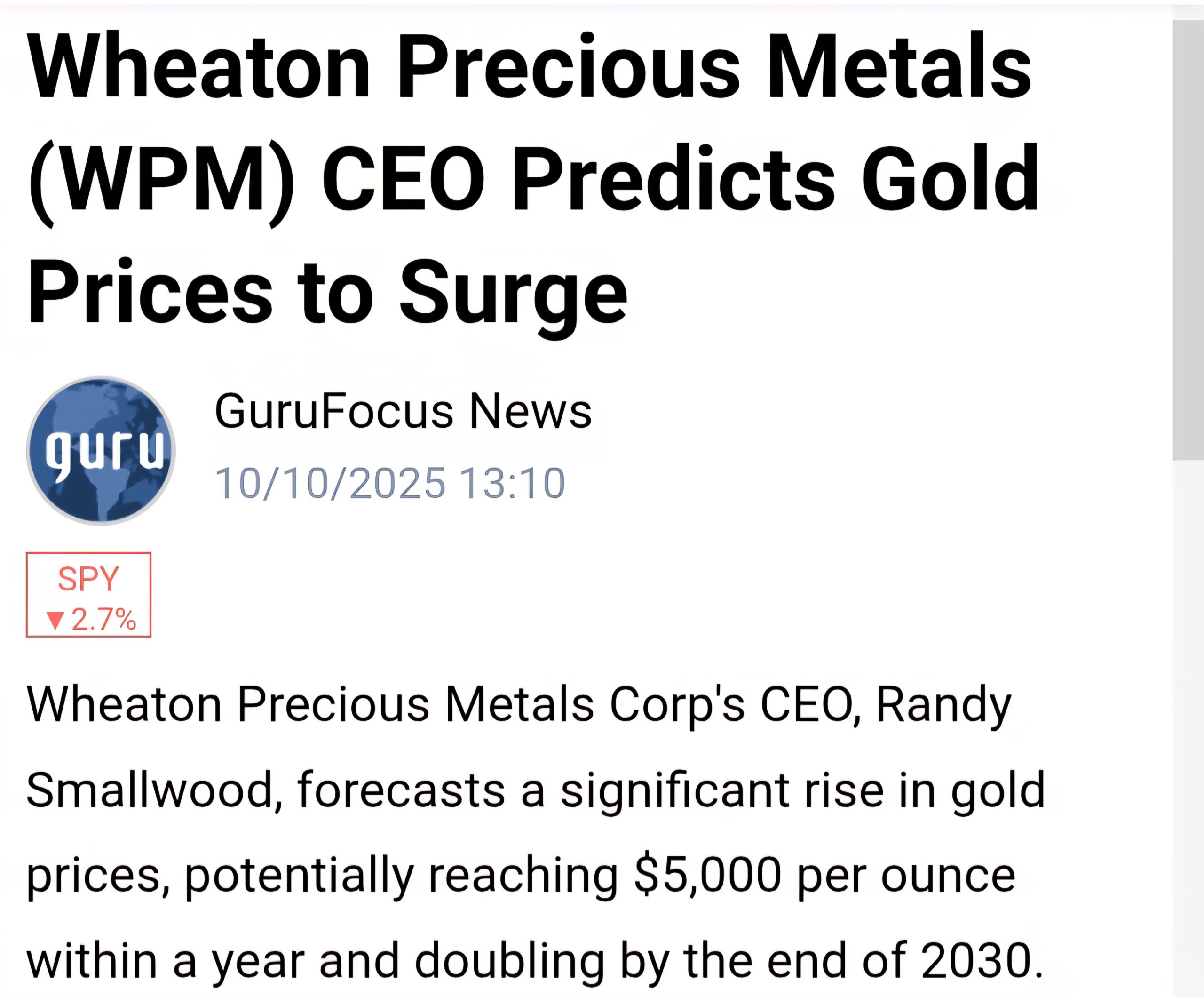
While Randy Smallwood, CEO of Wheaton Precious Metals, offers a compelling case for gold reaching $5,000 per ounce within the next year and doubling to around $8,000 by the end of the decade, his outlook underestimates the accelerating tailwinds propelling gold’s ascent. As of October 11, 2025, spot gold stands at approximately $4,016 per ounce—a staggering 51% year-to-date gain that builds on a steady, multi-year climb from $1,895 in 2020 to over $4,000 today. This isn’t a fleeting spike; it’s the culmination of gold’s historical resilience, delivering an average annual return of 10.9% over the past 25 years, with consistent upward momentum even in bull markets for equities. I firmly believe we’ll eclipse $10,000 well before 2029, driven not by panic over runaway inflation, but by the deliberate architecture of a robust, innovation-fueled economy where moderate inflation is a feature, not a bug.
Consider the foundation: a growing U.S. economy that’s recalibrating around calculated, predictable inflation rather than the volatile surges of yesteryear. Inflation expectations have stabilized at a manageable 3.4% for the coming year, with business leaders pegging it at 2.3%—levels that signal confidence in steady expansion, not crisis. This isn’t the “rapid” inflation that spooks markets; it’s the normal byproduct of a shifting economy where productivity gains from new industries outpace cost pressures. Global forecasts align, projecting inflation easing to 4.5% by 2025 while supporting GDP growth, allowing central banks to ease without fear of overheating. In this environment, gold thrives as a non-yielding store of value, appreciating steadily as real yields compress and investors seek ballast against currency dilution.
Enter President Trump’s aggressive push to reshape monetary policy, which will supercharge this dynamic. Trump has openly advocated for the Federal Reserve to slash rates to as low as 1%, pressuring the Fed through appointees like those calling for three-percentage-point cuts that could drop the federal funds rate below 2%. The Fed has already responded, trimming rates to 4.00%-4.25% in September 2025 amid softening hiring data and tariff impacts, with further cuts projected through 2026. This isn’t reckless easing—it’s a strategic borrowing growth model designed to ignite domestic investment. Lower rates will flood credit markets, bolstering banks and credit agencies strained by higher borrowing costs, while unleashing capital for high-return sectors. The result? A virtuous cycle of expanded lending that fuels not just recovery, but reinvention.
At the epicenter of this boom sits the AI and tech revolution, which is already rewriting economic gravity. Private AI investment hit a record $252 billion in 2024, surging 26% year-over-year and propelling U.S. GDP growth—without data centers and AI infrastructure, first-half 2025 expansion would have flatlined at 0.1%. This isn’t hype; it’s tangible: hyperscale data centers, AI chip fabs, and supporting logistics are sparking a construction renaissance, from sprawling server farms in Nevada to semiconductor plants in Arizona and Texas. These projects alone could add trillions in economic activity by 2029, creating ripple effects in local manufacturing—think steel for buildings, cabling for grids, and robotics for assembly lines. As AI scales, it demands localized supply chains, revitalizing national economies and drawing in foreign capital wary of global fragmentation.
But here’s the gold kicker: this tech-fueled prosperity will subtly erode the dollar’s dominance, amplifying gold’s allure. Lower rates weaken the USD, making imports pricier and embedding that “calculated” inflation into growth models—yet without derailing expansion. Investors, flush with AI gains, will rotate into gold for diversification, especially as central banks continue hoarding it amid geopolitical flux. J.P. Morgan’s forecast already eyes $3,675 by Q4 2025 and $4,000 by mid-2026, but that’s conservative; with Trump’s rate offensive and AI’s capex tsunami, the compounding effect could easily double that trajectory. Gold has already surged 108% over five years, outpacing even mining stocks in 2025. Extrapolate the steady 10-15% annual clips we’ve seen since 2020, layer on 2-3% annual inflation, and factor in 20-30% boosts from monetary easing and tech liquidity—$10,000 by 2028 isn’t a moonshot; it’s math.
Smallwood’s $5,000 call is a safe bet, but it misses the forest for the trees: we’re not heading into uncertainty; we’re engineering abundance. Gold won’t just hedge this era—it will define it, climbing inexorably as the economy we build demands a timeless anchor. By 2029, $10,000 will look like the floor, not the ceiling.
Why Gold Will Shatter Expectations: A Path to $10,000 Before 2029