







Exquisite Cosmic Coincidence

Story Read to you by me:
Exquisite Cosmic Coincidence
The Perfect Alignment of Sun, Moon, and Earth
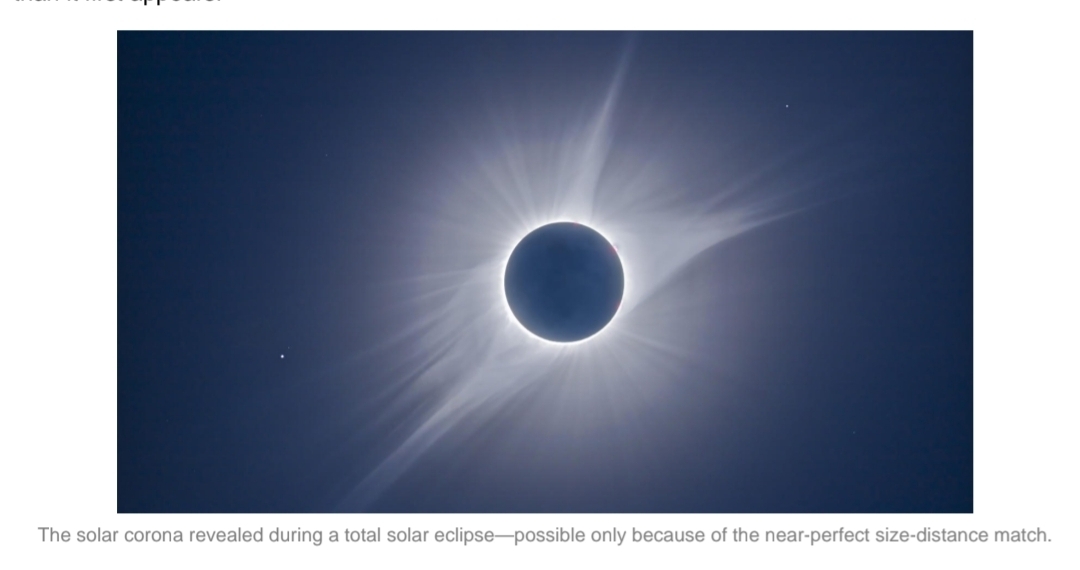
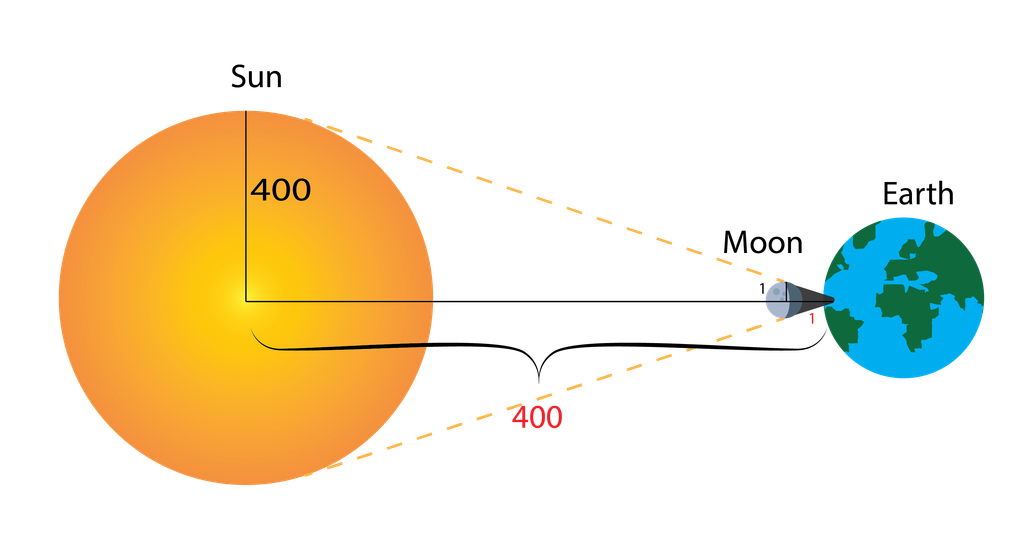
Of all the moons in our solar system—hundreds of them orbiting the gas giants and smaller worlds—none produces the precise, breathtaking spectacle of a total solar eclipse the way Earth’s Moon does. The Sun is roughly 400 times wider than the Moon, yet it also sits roughly 400 times farther away. From the surface of our planet, the two disks appear nearly identical in size. When the Moon passes directly between Earth and the Sun, it can cover the brilliant photosphere completely while leaving the ethereal white corona glowing around the edges. This is not a common arrangement. It is an exquisite cosmic coincidence—and one that is far more precise and improbable than it first appears.
The Diameters and Distances
To appreciate how delicately balanced this alignment is, consider the actual sizes and distances of the three bodies involved:
| Body | Diameter | Average Distance from Earth |
|---|---|---|
| Sun | 1,392,000 km (1.392 million km / \~864,000 miles) |
149,600,000 km (1 AU / \~93 million miles) |
| Moon | 3,474 km (\~2,159 miles) |
384,400 km (\~238,900 miles) |
| Earth | 12,742 km (\~7,918 miles) |
— |
Approximate values based on standard NASA and astronomical data. Diameters are commonly cited equatorial or volumetric mean figures.
Dividing the Sun’s diameter by the Moon’s yields a ratio of approximately 400.7. Dividing the Earth–Sun distance by the Earth–Moon distance yields approximately 389. The two ratios are remarkably close—close enough that the apparent angular diameters both hover near 0.5 degrees (about 30 arcminutes). A difference of only a few percent in either size or distance would destroy the possibility of a total eclipse that still reveals the corona.
How Easily This Could Have Been Off
The match is not a hard physical requirement of gravity or orbital mechanics. It is a contingent outcome of the giant impact that formed the Moon, the subsequent tidal evolution of its orbit, and Earth’s particular distance from the Sun. Small changes would produce very different results:
- If the Moon were only 10% smaller in diameter (about 3,127 km), or 10% farther away, it would always appear smaller than the Sun. Total eclipses would be impossible; we would see only annular “ring of fire” eclipses or partial coverings.
- If the Moon were 10% larger, or significantly closer, it would always appear larger than the Sun. Totality would still occur, but the corona would be hidden behind a larger lunar disk, and the dramatic diamond-ring and Baily’s beads effects would be diminished or lost.
- If Earth’s orbit were closer to the Sun (making the Sun appear larger) or farther (making it smaller), the match would fail even if the Moon remained the same.
- The Moon’s orbit is elliptical, so its distance varies by about 50,000 km between perigee and apogee. This already causes a mix of total and annular eclipses. A slightly different eccentricity or average distance would tip the balance permanently one way or the other.
In short, the geometry that allows the Moon to just cover the Sun—neither too large nor too small—is a narrow window. We happen to be living inside that window.
A Genuine Outlier Among the Moons
Roughly 200–300 moons are known in the solar system. Mars’s two moons, Phobos and Deimos, are far too small to produce total eclipses. The large moons of Jupiter, Saturn, Uranus, and Neptune produce either tiny transits or complete coverings that obscure the corona entirely when viewed from the cloud tops or hypothetical surfaces. No other planet-moon-star combination in our system yields the near-perfect match that reveals the solar corona from the ground. Earth’s arrangement is unique in the solar system for producing total solar eclipses of this quality and frequency.
Sun, Moon, and the Witness of Scripture
Scripture repeatedly presents the Sun and Moon as signs and markers of order, beauty, and divine purpose. While the Bible does not calculate angular diameters, it consistently treats the lights of heaven as purposeful works rather than random accidents.
Genesis 1:16
“God made two great lights—the greater light to govern the day and the lesser light to govern the night. He also made the stars.”
Psalm 19:1
“The heavens declare the glory of God; the skies proclaim the work of his hands.”
Joel 2:31
“The sun will be turned to darkness and the moon to blood before the coming of the great and dreadful day of the LORD.”
Amos 8:9
“In that day,” declares the Sovereign LORD, “I will make the sun go down at noon and darken the earth in broad daylight.”
Matthew 24:29
“Immediately after the distress of those days ‘the sun will be darkened, and the moon will not give its light; the stars will fall from the sky, and the heavenly bodies will be shaken.’”
Revelation 6:12
“I watched as he opened the sixth seal. There was a great earthquake. The sun turned black like sackcloth made of goat hair, the whole moon turned blood red…”
The Odds and the Wonder
There is no simple formula that calculates the “odds” of this alignment arising by chance, because the Moon’s size and distance are products of a specific formation history rather than independent random draws. Yet the result is still striking: out of all the moons in the solar system, only Earth’s produces this near-perfect covering that reveals the corona. The alignment is temporary—the Moon is receding at roughly 3.8 centimeters per year, and total eclipses will eventually cease. We are living in the epoch when the match is close enough to produce one of nature’s most dramatic spectacles.
Whether one interprets the exquisite coincidence as pure chance or as a signature of a loving and creative Creator, the phenomenon itself remains extraordinary. The numbers line up with a precision that is easy to miss and hard to dismiss. The heavens continue to declare something remarkable—and for a brief window of cosmic history, Earth’s Moon is perfectly placed to let us see it.